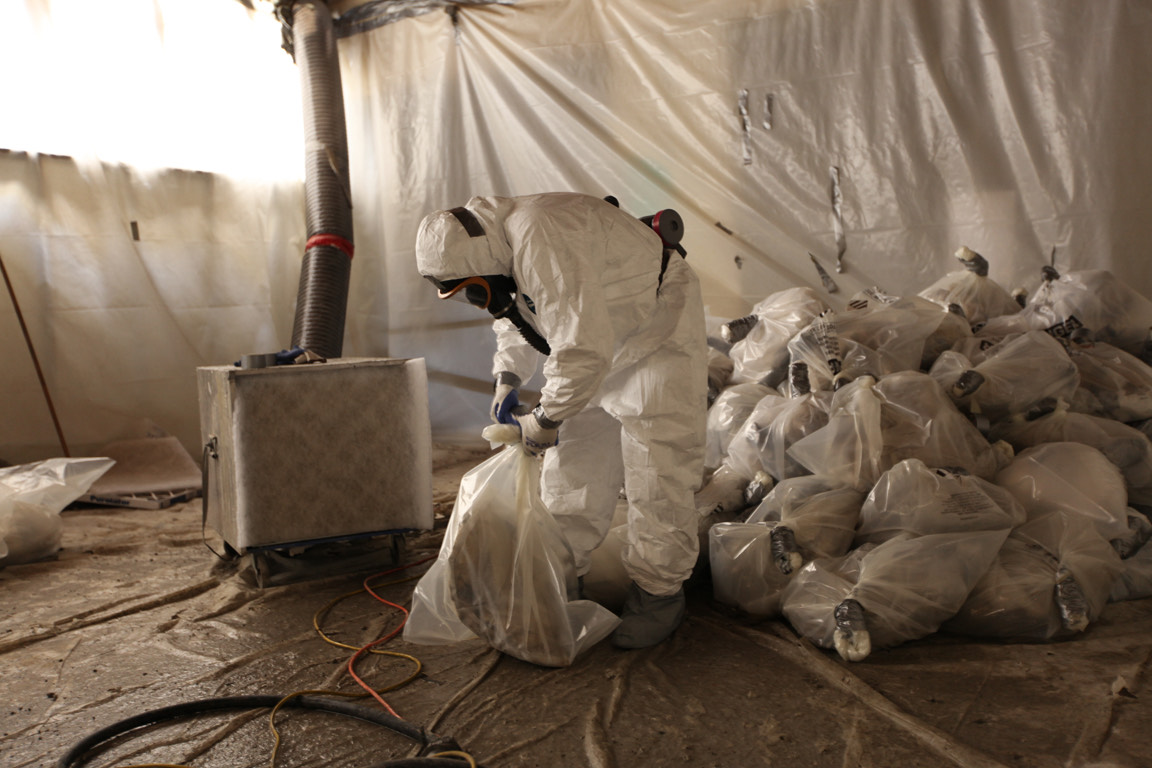
Asbestos Insulating Board (AIB): What It Is, Where It Is Found and Removal Cost
Asbestos insulating board (AIB) is a lightly compressed building board that looks a lot like plasterboard. It breaks easily and releases fibres when drilled or cut, so leave it alone. Most removal needs a contractor licensed by HSE. Asbestos insulating board removal typically costs £1,800 to £3,250 per job, plus VAT. We arrange testing and removal across the UK.
Think a board is asbestos? What to do now
People often find out when an electrician, plumber or builder stops work. They say a ceiling, a panel or the board behind the fuse box may be asbestos insulating board. It may turn out to be ordinary board. Until you know, four steps:
- Leave it alone. Don't drill, cut, sand or break it, and don't pull it down to look behind it.
- If it's already been drilled or broken, stop, keep people out of the room and tell us when you get in touch.
- Get it tested. We arrange asbestos testing. A home test kit isn't the way to check insulating board.
- If it's asbestos, get a quote before work starts again. We arrange removal across the UK. Work that needs a licence goes to an HSE-licensed contractor.
What is asbestos insulating board, and what was it used for?
Asbestos insulating board, or AIB, is a lightly compressed board. It's made from asbestos fibre and Portland cement or calcium silicate, with other fillers.
It usually contains 15 to 25 per cent brown asbestos, sometimes mixed with white. Other names for it are Asbestolux, asbestos wallboard and insulation board.
It was commonly used for fire protection. It was also widely used for partition walls and linings, and for sound and heat insulation. Suspended ceiling tiles were often made from it.
- When it was made. Manufacture stopped in 1980, and brown asbestos was banned by law in 1985. No official source we hold gives a separate ban date for the board. Board already fitted stayed where it was.
- What that means for your home. A surveyor can treat building work after 1985 as a reason to conclude the board is absent. But HSE's general rule is still that any building built or refurbished before 2000 may contain asbestos. Only a test settles it.
Asbestos insulating board was most widely used as: which answer?
If you're here for the asbestos awareness question, ceiling tiles is the choice HSE's own lists support best. They don't rank the uses, so we can't confirm which answer your test expects. Here's what they say about the four usual choices:
- Ceiling tiles. In every list of board uses. Suspended ceiling tiles were often made from it.
- Roofing sheets. Listed as asbestos cement, a different material.
- Electrical flash guards. Listed separately from the insulating board behind a fuse box.
- Floor boarding. Not in the lists of board uses, though the survey guidance mentions board inside some suspended floor systems.
Is it asbestos insulating board or plasterboard?
They're different materials, and you can't tell them apart by looking. Insulating board closely resembles typical plasterboard. HSE says it's hard to tell the difference between it and boards with no asbestos in them.
- Ordinary plasterboard is very unlikely to contain asbestos. The worry is board that looks like plasterboard and isn't.
- Board behind board. Insulating board can be sandwiched between, or faced with, other materials, including plasterboard. A plain surface doesn't tell you what's behind it.
- Home tests don't work. No colour, thickness or tapping test is reliable. Surface texture, sound and hardness are only aids for experienced surveyors. Knocking or scratching the board disturbs it.
- Putting up shelves? If the wall or ceiling is in one of the places listed below, or you're not sure what the board is, have it tested before you drill.
Only a lab test settles it. The sample should be taken by someone trained and competent, such as a surveyor or a lab analyst. That's because sampling a higher risk material can release fibres. We arrange asbestos testing that way.
Where is asbestos insulating board found in a home?
HSE's drawing of a typical home marks these places. Any of them may have been painted since.
- Around the boiler and in the airing cupboard.
- Ceilings, as ceiling tiles.
- Partition walls.
- Behind the fuse box.
- Behind a fire.
- Bath panels, window panels and soffits (the boards under the eaves; see our asbestos soffits guide). These may be insulating board or asbestos cement. Treat them as insulating board until a test says otherwise.
Fire door panels can be board too. Board ceiling panels can have a textured coating on them. Removing a coating that covers board is a job for a licensed contractor, which matters if you have an Artex ceiling.
For the other materials in a home, see where asbestos is found in UK homes.
Is asbestos insulating board dangerous, and can it stay?
It's one of the higher risk asbestos materials, and it can often stay where it is. Both are true because the risk comes from disturbing it.
The board breaks easily, releasing a lot of fibres, and sawing and drilling do the same. Breathed in, asbestos fibres can cause serious diseases.
By contrast, work with asbestos cement doesn't pose the same risks. More in our guide: is asbestos dangerous?
HSE's advice to householders depends on the board's condition:
- Good condition. If it's unlikely to be damaged, it's often best left where it is and checked from time to time.
- Slight damage. This can sometimes be repaired by sealing or enclosing it, but only by someone trained.
- Bad damage. Badly damaged board that's likely to be damaged further should be removed if it can't be protected.
Painting sound board is on the list of tasks trained workers can do without a licence. It isn't a job for a householder.
Planning work on the room? Have the board tested before anything is drilled, cut or fixed to it. If it's asbestos, nobody untrained should drill or fix anything to it. If it has to come out, we arrange the removal. Get a free quote.
Who can remove asbestos insulating board?
In most cases, a contractor licensed by HSE. Most work with this board needs a licence, and HSE's advice to householders is that only a licensed contractor should remove it.
The rules sort work into three kinds. It helps to know which one your job is.
Licensed work: most removal
- Examples: most work to remove the board, any work on board in poor condition, and clearing up board debris. Also taking out board partition walls, linings and suspended ceilings.
- The contractor must tell the enforcing authority at least 14 days before work starts, unless the authority agrees a shorter time. Allow for that when you plan other work.
- It ends with a four-stage clearance and a certificate for reoccupation. That says the area is clean and fit to go back into.
Notifiable work: a short removal job
- Example: a short job to remove board during a refurbishment, such as screwed-on panels taken off after water damage.
- No licence is needed, but the firm must notify the work before it starts.
- Be wary of this one. HSE has found that a significant share of board jobs notified this way ran over the time limit and should have been licensed.
Non-licensed work: a few short tasks
- Examples: repairing minor damage, short jobs drilling holes (for example to put up shelves), painting sound board, and taking off and refixing a loosely fixed panel, such as a bath panel, to reach something behind it.
- These are jobs for workers trained in non-licensed asbestos work, not for householders.
What separates them is mostly time and condition. A short job is no more than two hours of work in total in any seven days, with no one person working more than an hour. That includes setting up and clearing up. Anything longer, and any board in poor condition, is licensed work.
A short job still needs a licence if it's likely to release a high level of fibres. Removing more than two small panels in a week also needs a licensed contractor.
Before you hire anyone, three checks:
- Ask which kind of work the firm says your job is, and why.
- For licensed work, ask for the licence number and look the firm up. HSE's licensing page links to the current list of licensed asbestos contractors.
- Ask what the quote covers, including the clearance at the end.
These rules cover England, Scotland and Wales. In Northern Ireland, the regulator is HSENI.
For every other material, see which asbestos work needs a licence.
We arrange asbestos removal across the UK. Work that needs a licence goes to a licensed contractor. Get a free quote.
What does it cost to remove asbestos insulating board?
Asbestos insulating board removal typically costs £1,800 to £3,250 per job, plus VAT. That covers board in one part of a home, such as the panels in one room or one ceiling.
Asbestos insulating board removal
£1,800 to £3,250
per job, plus VAT
The area, how easy it is to reach and the enclosure the work needs all affect the price.
The price doesn't fall in step with the area. Licensed work has the same main requirements whatever its size: notice before it starts, an enclosure for most indoor work, and the clearance at the end.
So the range doesn't describe one small panel or a whole house, which are priced on their own. Soffits, a test and making good afterwards aren't included.
For your own price, tell us on the form where the board is, roughly how big an area, and whether it's damaged. Your price depends on the job. Every quote is free. Prices are shown before VAT unless they say otherwise. How we work out these prices.
Can asbestos insulating board go to the tip?
Don't take it there. We can get it taken down and taken away for you. If you already have loose pieces, tell us and we'll be in touch about having them dealt with.
None of the 189 council entries we've checked, up to 11 October 2026, names insulating board as something it takes. The seven that mention it by name all point to a licensed contractor.
One council says it takes "plasterboard containing asbestos" without saying what that covers, so ask before assuming. Look up your own council.
Council schemes are for small amounts that have already been taken down and wrapped. For anything more, or anything still in place, we arrange the whole job.
When a tradesperson removes the board, the waste they produce is theirs to remove and dispose of correctly.
If you're in Scotland. Asbestos waste there is special waste, regulated by the Scottish Environment Protection Agency. See how to dispose of asbestos in Scotland.
Key takeaways
- Treat board in the places listed above, in a home built or altered before 2000, as suspect until tested.
- Never drill, cut, sand or break it, and don't take it down to check.
- Leave board in good condition where it is, and have damaged board looked at.
- Use an HSE-licensed contractor for removal, and check the licence.
- Get a quote for the whole job: a small area doesn't always mean a small price.
Primary Sources & Further Reading
- HSE: Locations of asbestos and taking the right action (asbestos insulating board)
- HSE: Asbestos FAQs
- HSE: Licensable work with asbestos
- HSE: Notifiable non-licensed work
- HSE: Non-licensed work with asbestos
- HSE: Diagrams showing where asbestos can occur in buildings
- HSE: Sourcing professional advice and services on asbestos issues
- HSE: A worker's guide to asbestos safety
- HSE: Why asbestos is dangerous and where it can be found
- HSE: Asbestos, the survey guide (HSG264)
- HSE: Managing and working with asbestos, approved code of practice (L143)
- HSE: Introduction to asbestos essentials (sheet a0)
- HSE: Legislative and guidance proposals for the Control of Asbestos Regulations 2012 (consultation, closed 9 January 2026)
- HSENI: Asbestos (Northern Ireland)
- GOV.UK: Dispose of household waste
Photo: NAVFAC, CC BY 2.0 (creativecommons.org/licenses/by/2.0), via Wikimedia Commons.